


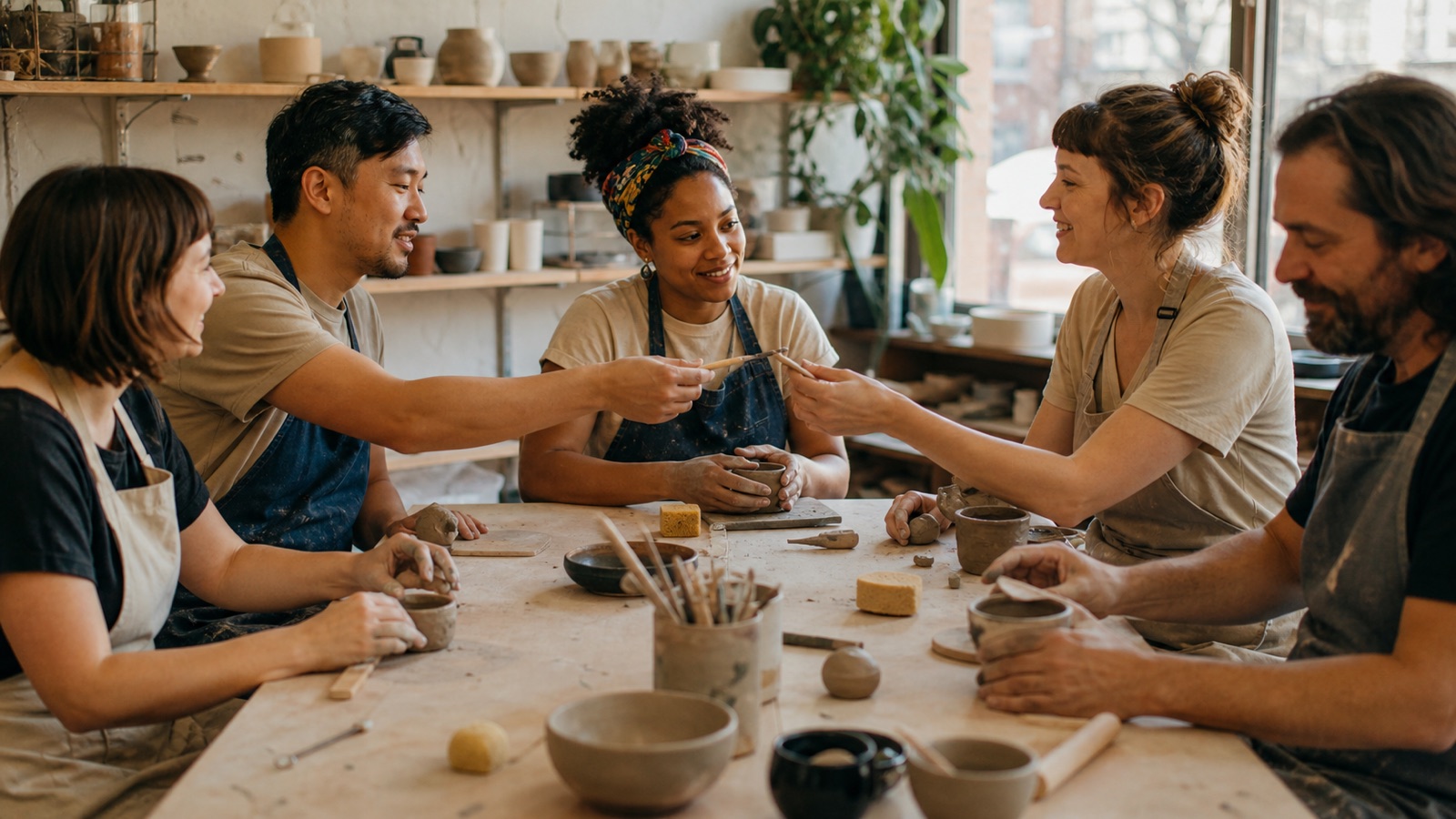
Adults often make friends more easily through a recurring hobby because the activity supplies a reason to gather, something to talk about, and a next meeting already on the calendar. The hobby opens the door. Repeated participation lets people recognize one another, continue conversations, and decide, slowly and without much theater, whether they want to become friends.
Pick a hobby you can repeat on an ordinary week. Friendship requires frequency, and frequency requires logistics you can live with.
What does the News & Observer article get right?
The News & Observer recently explored why adults are turning to hobbies, clubs, and shared interests to make friends. The piece moves from run clubs and book groups to pottery, gardening, cooking, crafts, and dance. Its clearest insight is simple: people feel less exposed when everyone has already agreed to do something together.
A networking mixer makes the conversation itself the assignment. A pottery class gives you clay to complain about. A run club gives you a route, a pace, and the low-stakes question, “Have you done this one before?” Shared activity takes some of the weight off every sentence.
The article also lists several hobby and activity platforms. They illustrate how technology can help people find a starting point, but the list is not a measure of how adults actually meet. The more durable lesson is about the shape of the gathering: repeated, participatory, and easy enough to enter alone.
The News & Observer discloses that its piece was produced by content specialists using tools that included AI. We checked the research claims discussed here against the original friendship-time study and the underlying APA and AARP sources.
Why does repetition matter more than choosing the perfect hobby?
A brilliant first night can still end as one nice memory. A merely decent Tuesday group can become part of your life because the same people return and the next meeting requires no fresh negotiation.
Jeffrey Hall studied friendship development among adults who had recently moved and first-year college students. Across the two studies, accumulated time together was associated with greater closeness, and leisure time predicted closeness in the recent-mover sample. The findings do not set a deadline for friendship. One sample relied on people estimating past time, and an association cannot promise what will happen between two specific people. The useful takeaway is smaller: closeness needs opportunities to accumulate. Read the original friendship-time study.
Current survey data point to the practical obstacle. In a nationally representative 2025 survey of 1,488 U.S. adults, AARP found that nearly nine in ten respondents were open to new friendships. Many also said friendship gets harder with age, with time constraints and a lack of social opportunities among the barriers. Among adults who had intergenerational friends, shared interests or hobbies were one of the most common links between them. See the AARP Friendship Study.
A recurring hobby turns vague openness into a usable schedule. “I want more friends” is difficult to place on a calendar. “Beginner pottery, Thursdays at 7” fits neatly.
Can hobbies support mental health too?
The News & Observer piece cites a 2023 American Psychiatric Association poll of 2,202 adults. Among respondents who described their mental health as very good or excellent, 71% said they engaged in creative activities frequently, compared with 50% of those reporting good mental health and 46% of those reporting fair or poor mental health. Creative activities included music, puzzles, dancing, art, crafts, writing, gardening, and cooking. Read the APA poll summary and methodology.
That result is correlational. The poll cannot tell us whether creative activity improved mental health, whether people feeling better participated more often, or whether both were true. It also did not test whether people did those activities in groups. Still, a hobby can make a week richer while friendship develops at its own pace. You moved your body, practiced a skill, made something lopsided, or read a book you would have abandoned on page 42. The evening already counted.
What makes a hobby group friendship-friendly?
Judge the actual group as carefully as the hobby label. A warm book club that meets every other week can offer more continuity than a giant fitness class with a different crowd every day.
| Look for | Why it helps | What to check |
|---|---|---|
| A real cadence | Repetition is built into the calendar | Can you see and save the next three dates? |
| Returning participants | Conversations can continue instead of restarting | Ask whether the same people usually attend this session |
| A shared task | The activity supplies natural conversation | Favor making, moving, playing, learning, or serving together |
| Conversational edges | Arrival, breaks, rotations, and cleanup create openings | Does everyone leave the second the activity ends? |
| A clear solo entry | A first-timer can join without bringing a partner or team | Confirm the host, check-in process, level, and equipment |
| Realistic access | You can return when motivation is average | Test the cost, travel time, schedule, and physical demands |
Our ranked guide to activities for making friends compares common formats using recurrence, participation, conversation, solo friendliness, continuity, and access. The scores are editorial tools rather than universal rules. A well-run local group can outperform its category.
How do you turn hobby acquaintances into friends?
Let the first few visits build continuity. Your goal is to give a promising conversation a next chapter.
| Visit | Small job | Try this |
|---|---|---|
| First | Learn the room and one name | “Hi, I’m new. Is there anything a first-timer should know?” |
| Second | Use the name and continue one thread | “Good to see you again. How did that project turn out?” |
| Third | Make a small adjacent invitation when the warmth is mutual | “I’m grabbing coffee next door after this. Want to come?” |
Three visits are a planning frame, not a social law. Some people click sooner. Other groups need six weeks before names stick. Look for reciprocity: they remember something, ask you a question, seek you out, or offer another time when they cannot join.
If walking in alone is the hardest part, use the first-timer arrival script. For invitations and follow-up, see the six-step plan for making friends as an adult.
What should a friendship app actually do?
The News & Observer article names platforms for finding runs, hikes, books, crafts, classes, and local groups. A useful discovery tool should shorten the distance between interest and participation. It should tell you where to go, when to arrive, whether beginners come alone, what to bring, and whether the same people are likely to be there next week.
The meaningful outcome happens after the search. You put the plan on your calendar. You walk into the room. You return when you are no longer brand new. The app earns its place by helping those steps feel possible.
That is the idea behind Hey Sammy: weekly plans near you where familiar faces can turn into real friends over time. The app helps with the messy logistics. You provide the part no recommendation system can automate, which is showing up again.
What should you do this week?
- Choose one two-hour window you can protect most weeks.
- Find one participatory activity that fits that window and welcomes solo newcomers.
- Confirm the exact date, location, cost, booking step, equipment, and arrival instructions with the organizer.
- Save the next three sessions before the first one happens.
- Make your first goal one name and one return date.
The hobby can be pottery, pickleball, volunteering, dance, books, running, gardening, cooking, or something gloriously specific that your friends will never stop teasing you about. Choose the room that makes a second visit realistic.
Find a weekly plan near you with Hey Sammy, add it to your calendar, and start becoming a regular.
Related reading: why familiar faces make friendship easier.
Sources
- Wickes, H. (2026). What Comes Next as More Adults Turn to Hobbies, Clubs and Shared Interests to Make Friends. The News & Observer.
- Hall, J. A. (2019). How many hours does it take to make a friend? Journal of Social and Personal Relationships, 36(4), 1278 to 1296.
- American Psychiatric Association. (2023). New APA Poll: Americans Who Engage in Creative Activities at Least Weekly Report Better Mental Health.
- Bridges, K. (2026). The Friendship Study. AARP Research.