


of Americans socialized on an average day in 2025, down from 38% in 2015.
01We're trying to reverse a decades-long decline in showing up.
Americans, especially young Americans, spend less time together in person than any generation on record. Hey Sammy exists to bend that line back: one person, one recurring activity, one real place at a time.
See the numbersWe have more ways to communicate, but fewer reasons to be together.
School once gave us repeated contact for free. So did neighborhoods, offices, clubs, and community organizations. Adult life removed many of those built-in collisions, then handed us a screen that asks nothing from us except that we keep scrolling.
Connection belongs beside movement, sleep, and nutrition.
Loneliness is an emotion. Social isolation is a circumstance. Neither is a character flaw, but chronic disconnection is a real health risk, and strong relationships are a real protective factor.
greater odds of survival were associated with stronger social connection across 148 studies.
more likely to report very good or excellent health among people with a very strong sense of community belonging.
Associations summarized by the U.S. Surgeon General. Source 07
Friendship is an environment before it becomes a relationship.
Most friendships do not begin with one perfect conversation. They begin with conditions that make the next conversation easier.
-
01
Shared activity
Something natural to do and talk about.
-
02
Repeated contact
The same room, rhythm, and people.
-
03
Familiar faces
Recognition lowers the stakes.
-
04
Trust and friendship
Shared history accumulates.
Where close friendships begin
Repeated places do more work than perfect introductions.
Americans most often report meeting a close friend through places and networks that create recurring contact. Respondents could choose more than one setting.
Share of Americans with close friends who report meeting one in each setting. Source 03
We need more third places.
Sociologist Ray Oldenburg called them third places: spots beyond home and work where people gather informally and become known. A run club, a dance social, a pottery studio, a volunteer shift, a rec league. They work because they bundle everything friendship needs: an activity, a rhythm, and familiar faces, all within one recurring commitment. And they're closing across the country, which makes finding the ones still thriving matter more, not less.
- Something to do, so talking is easy
- A schedule, so the hours accumulate
- Regulars, so faces become familiar
- A skill to learn, so you grow while you belong
- A next week, so no single visit carries the pressure
I Can Relate
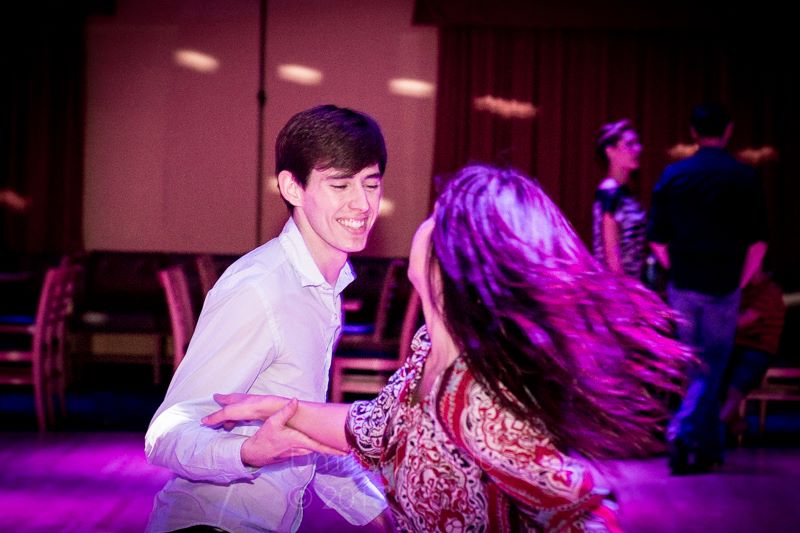
I took a year off during my junior year of college because I was pretty lost. During that time, a friend invited me to learn ballroom dance at a house on the east side of Tucson. The parents taught all the kids, and the kids invited their friends. I like saying yes to things, so I tried it on a whim—and ended up loving it. It was social, challenging, and musical, and I kept going back once or twice a month.
After about a year, I saw that a ballroom dance studio in Tucson was hiring and thought, “Hey, why not get paid to learn and spend more time doing something I’m having fun with?” That led me to West Coast Swing, then to dance conventions in California, and eventually to San Francisco after I connected with the community here.
Looking back, I put myself in a position to get lucky simply by showing up and saying yes. I said yes to coaching high school track and field, which eventually led to a friend asking me to try ballroom dancing. I said yes to an opportunity at a ballroom dance studio. And I said yes when I was offered the chance to learn West Coast Swing. Each yes opened the door to another.
I’ve deeply felt the benefits of putting yourself out there—trying things, talking to people, and letting those small choices compound. If you’re positive, friendly, helpful, curious about the world and other people, and genuinely care about them, they’ll remember that.
Ultimately, Hey Sammy is my attempt to give other people the kinds of opportunities I had. I want to help them take those first steps: try something, meet people through it, and keep going back long enough for those friendships to grow. My best-case outcome would be hearing stories from people who put themselves out there with a little inspiration from me and went on to radically transform their lives. Hearing that one day would be deeply fulfilling.
Built for a public benefit.
Hey Sammy is a registered public benefit corporation. Our stated public benefit is to create media and technology that helps young adults build fulfilling lives. We're starting with a practical part of that mission: helping people find places worth returning to, form close friendships, build real skills, and become part of the communities around them.
Sources and notes
Last reviewed August 6, 2026. Statistics describe populations, not individual destinies.
-
01
U.S. Bureau of Labor Statistics, American Time Use Survey; 2025 estimates as reported by Axios, July 2026.
-
02
Derek Thompson, The Anti-Social Century, The Atlantic, February 2025, analyzing American Time Use Survey data. The 2019 in-person estimate covers ages 15–25.
-
03
Survey Center on American Life, The State of American Friendship, 2021, compared with Gallup, 1990.
-
04
Derek Thompson, The Death of Partying in the U.S.A., 2025, analyzing American Time Use Survey data, 2003–2024.
-
05
Jean M. Twenge and Heejung Park, The Decline in Adult Activities Among U.S. Adolescents, 1976–2016, Child Development, 2019; licensure figures from Monitoring the Future analyses.
-
06
Gallup, Teens Spend Average of 4.8 Hours on Social Media Per Day, 2023.
-
07
Office of the U.S. Surgeon General, Our Epidemic of Loneliness and Isolation, 2023.
-
08
Julianne Holt-Lunstad, Timothy B. Smith, and J. Bradley Layton, Social Relationships and Mortality Risk: A Meta-analytic Review, PLOS Medicine, 2010.
-
09
Harvard Study of Adult Development; see also the Harvard Gazette summary: relationship satisfaction at age 50 predicted later health better than cholesterol levels.
-
10
Karen Mak et al., Hobby engagement and mental wellbeing among people aged 65 years and older in 16 countries, Nature Medicine, 2023.
-
11
Jeffrey A. Hall, How many hours does it take to make a friend?, Journal of Social and Personal Relationships, 2019. Hours are rough thresholds, not guarantees.
-
12
Harvard Kennedy School Institute of Politics, Harvard Youth Poll, Spring 2023.
-
13
Pew Research Center, What does friendship look like in America?, 2023.
-
14
NORC, General Social Survey cumulative data, 1972–2024; Hey Sammy analysis of the documented social-evenings-with-neighbors measure using cumulative survey weights. Collection shifted to mixed mode after 2018.
-
15
Robert D. Putnam, Bowling Alone: America’s Declining Social Capital. The carousel shows the approximate early-1960s peak and 1997 endpoint for 32 chapter-based associations. It is a schematic comparison, not an annual series or physical-place count.
-
16
Max Planck Institute for Demographic Research, Understanding the Growth of Solitary Leisure in the U.S., 1965–2018. Social share is calculated from the paper’s weighted social and solitary leisure means for adults ages 19–65.
-
17
U.S. Census Bureau, 2003 and 2023 County Business Patterns. Selected NAICS employer-establishment snapshots are indexed to 2003; industry and administrative changes mean the lines should be read directionally.
-
18
Survey Center on American Life, 2019 baseline, 2021 community-place findings and 2025 follow-up. All three surveys used the same question wording.
-
19
U.S. Bureau of Labor Statistics, American Time Use Survey series TUU10101AA01013951, 2003–2025. Values measure primary-activity socializing and communicating among people ages 15 and older; there is no annual 2020 estimate.